

By Kent Redfearn, Ph.D. · November 4, 2026
Second Curve Coaching Blog · Preparing for the Second Curve, Part 1
Many of us only begin something new in our lives when we must: A job loss. A medical diagnosis. The church votes. The company restructures. The children move out. Your body says no more. Then, once exhausted and grieving, folks start looking for what comes next.
There is another way. It is harder to see and harder to choose, because it asks us to begin the next season while the current one is still going well. That is the quiet wisdom at the heart of the second curve, and it is where this series begins.
The Paradox of the Second Curve
Management philosopher Charles Handy gave much of his career to a simple model: the S-shaped curve, which he called the Sigmoid Curve. Almost every living thing experiences it. A marriage, a ministry, a career, an organization, even a human body begins slowly, rises, peaks, and then declines.
Handy’s primary insight was not that decline comes. That is common knowledge and experience. His insight was about timing. The crucial moment to begin a second curve is not at the bottom, and not even at the peak. It is at point A, while the first curve is still climbing. There, you still have the time, the energy, and the resources to get through the awkward, uncertain early stage of something new before the old curve begins to fall.
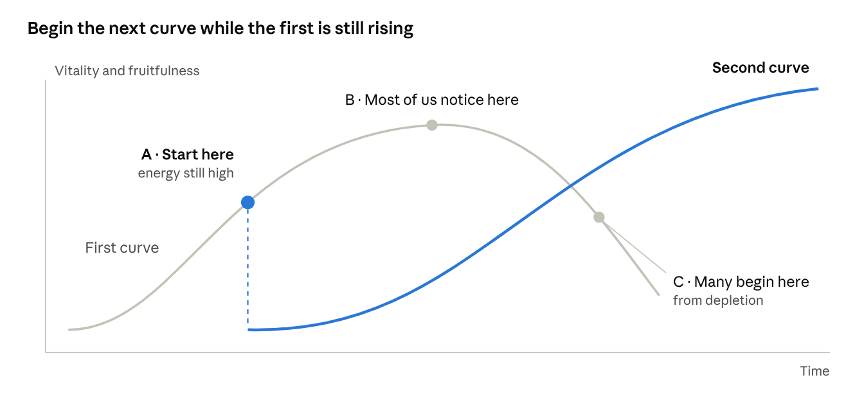
The second curve · after Charles Handy’s Sigmoid Curve
Here is the paradox. At point A, everything looks fine. Nothing is forcing a change, so starting something new feels unnecessary, even disloyal. By the time the need is obvious, at point B or later, much of the energy we needed has already been spent.
Joseph and the Years of Plenty
Long before Handy drew his curve, Scripture told the story of a man who understood it.
In Genesis 41, Pharaoh dreams of seven fat cows devoured by seven thin ones. Joseph, fresh from prison, interprets the dream: seven years of great plenty are coming, followed by seven years of famine. Then he does something remarkable. He doesn’t only explain the future; he tells Pharaoh how to prepare for it. Set aside one-fifth of the harvest during the good years, he says, and store it in the cities.
“That food shall be a reserve for the land against the seven years of famine that are to occur in the land of Egypt, so that the land may not perish through the famine.” (Genesis 41:36, ESV)
Notice when the work happened. Joseph didn’t build the storehouses during the famine. He built them during the years when the fields overflowed, and no one felt any need. The abundance itself was the resource that made preparation possible. Wait until the famine, and there’s nothing left to store.
It would have been easy to call Joseph’s plan pessimistic. Why hold back a fifth of the grain when the harvest is the best anyone can remember? But Joseph wasn’t acting from fear. He acted from revelation and faithful stewardship of a season God had given. Proverbs points to the same wisdom in the smallest of creatures: the ant “prepares her bread in summer and gathers her food in harvest” (Proverbs 6:8, ESV).
Preparing for the second curve is not a lack of faith in the first. It’s a way of honoring what God is giving you now.
Why We Wait
If starting early is so wise, why do so few of us do it? Part of the answer lies in how our brains are built.
We feel losses more than gains. Psychologists Daniel Kahneman and Amos Tversky showed that a loss weighs on us more heavily than a gain of the same size. Starting a second curve means giving up some time, comfort, or status we already have, in exchange for something we can’t yet see. The brain tallies the loss first.
We favor what we know. Researchers call it status quo bias: when nothing forces a decision, we tend to keep things as they are, even when change would serve us better. A rising first curve offers no reason to move.
Stress narrows our thinking. Neuroscientist Amy Arnsten’s research shows that under significant stress, the prefrontal cortex, the part of the brain that plans, imagines, and weighs options, loses much of its effectiveness, while older, more reactive circuits take over. Economists Sendhil Mullainathan and Eldar Shafir describe something similar with scarcity: when time or money runs short, our attention tunnels onto the urgent and loses sight of the important.
Put those together, and you can see the trap. At point A, we have the clear mind and the resources to plan, but little motivation. At point C, we have plenty of motivation, but we’re planning from a brain under threat. Starting early lets us make one of life’s biggest decisions with our wisest selves.
A word of grace. Perhaps your second curve wasn’t chosen. A layoff, an illness, a betrayal, or a loss forced it on you. If so, please hear this: you are not behind, and you have not failed. Joseph’s own life turned on transitions he never chose. His brothers sold him, and he was forgotten in prison. Years later he could say to them, “You meant evil against me, but God meant it for good” (Genesis 50:20, ESV). Starting from point C is harder, but God has never been limited to point A. And what you learn there can help you start the next curve earlier.
My Own Point A
I pastored one congregation for forty years. By most measures, that first curve was still rising when I began a Ph.D. in performance psychology. No one required it of me. My choice to prepare, at Point A, was driven by lifetime goals and a sense of calling. As a child, I promised myself I would pursue a Ph.D. I chose a bachelor’s degree in religion and philosophy as the foundation for my future studies. Further motivation came from reading a concept in one of Robert Greenleaf’s books (if I recall correctly) that the writing of the book was the result of him having decided and planned years ago what to do when his first curve was completed. For many years, I was at Point A. At 60, with everything going very well, I decided to begin the process of launching my second curve.
Those years of study were my storehouse. I didn’t fully know what I was storing grain for. Midway through the degree, the next season came into view, and I gave two weeks’ notice and stepped into a new role. The uncertainty was palpable. I could feel it in my veins and deep in my soul. Making the leap into my second curve feels like enjoying a sunrise rather than riding off into the sunset.
Looking back, I can see that the preparation made the leap possible. Grieving my movement away from the beauty and meaningfulness of what was, to embrace the possibilities resident in the land of uncertainty, was far more challenging than I anticipated. The many miracles of provision I have experienced on this part of the journey give me the confidence to say, “Jesus is Lord over the second curve.” Great is His faithfulness.
Storing Grain: Five Reserves to Build Now
Joseph’s plan was simple: set aside a portion of the harvest while it’s plentiful. You don’t need to know exactly what your second curve will be to start storing grain for it. Here are five reserves worth building while your first curve is still strong:
- Time. Protect a small, regular portion of your week for exploring what might come next: reading, conversations, a class, a volunteer role. This week: put one hour on your calendar and guard it.
- Learning. Grow a skill or body of knowledge your current role doesn’t require. Learning keeps the brain adaptable, and it opens doors you can’t yet see. This week: name one thing you’ve always wanted to learn.
- Relationships. Build friendships and mentoring relationships beyond your current title. When a role ends, relationships that depended on it often fade. This week: reach out to one person outside your usual circle.
- Health. Your body and nervous system will carry you into the next season. Sleep, movement, and practices that calm the stress response are not luxuries; they’re provisions. This week: choose one rhythm of rest to protect.
- Soul. Root your identity in who you are before God, not in what you do. This is the reserve that keeps a transition from becoming a crisis. This week: finish this sentence in prayer: “Lord, apart from my role, I am…”
You don’t need to build all five at once. Joseph set aside a fifth, not the whole harvest. Start with one.
Where Are You on the Curve?
Take a moment to look at the picture above. Are you still climbing toward point A? Near the peak at point B? Already on the downslope, or starting over from point C?
Wherever you are, there’s a next faithful step. If you’re still rising, this may be your season of plenty. Store some grain.
I’d love to hear from you. Leave a comment here or on my Facebook page: Where do you see yourself on the curve right now?
May the God who gave Joseph wisdom in the years of plenty give you eyes to see your season clearly, and courage to begin before you must.
Next week, Part 2: “Listening for the Nudge: How to Know a Season Is Ending.”
Kent Redfearn, Ph.D., is the founder and president of Second Curve Coaching. If you’d like a guide as you prepare for your own second curve, learn more about our Coaching Pathway at https://secondcurvecoaching.com/coaching-pathway/
References
- Arnsten, A. F. T. (2009). Stress signaling pathways that impair prefrontal cortex structure and function. Nature Reviews Neuroscience, 10(6), 410–422.
- Handy, C. (1994). The empty raincoat: Making sense of the future. Hutchinson. (Published in the U.S. as The age of paradox.)
- Handy, C. (2015). The second curve: Thoughts on reinventing society. Random House.
- Kahneman, D., & Tversky, A. (1979). Prospect theory: An analysis of decision under risk. Econometrica, 47(2), 263–291.
- Mullainathan, S., & Shafir, E. (2013). Scarcity: Why having too little means so much. Times Books.
- Samuelson, W., & Zeckhauser, R. (1988). Status quo bias in decision making. Journal of Risk and Uncertainty, 1(1), 7–59.
Scripture quotations are from the ESV® Bible (The Holy Bible, English Standard Version®), copyright © 2001 by Crossway, a publishing ministry of Good News Publishers. Used by permission. All rights reserved.